|
Glen Moore Company No.1 History
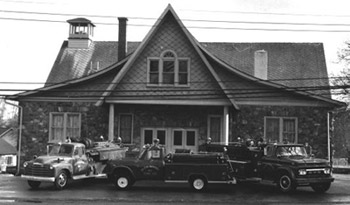
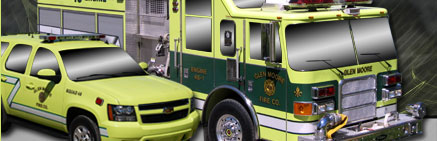
The Glen Moore Fire Company is located on Fairview Road at the intersection of Rt282 (Creek Road) in the village of Glen Moore. We provide Fire, Rescue and EMS services to Townships of Wallace, East Nantmeal, West Nantmeal and Upper Uwchlan. Glen Moore Fire Companies services are provided by highly trained and dedicated members who volunteer their time to help you!
Fire Protection for the community of Glen Moore, Wallace Township was first considered in 1912 by the Glen Moore Improvement Society. At that time a committee of David G. Byerly, William H. Miller, Harry Benner, William Tulloch and C. Wilmer Dickinson held a festival in Glen Moore Park. The main attraction was a parade of decorated vehicles and autos. With the proceeds, 4 hand fire extinguishers were purchased and two were placed in the Post Office (the little building next to the methodist Parsonage) and the other two in Elmer B. Dunwoodys Merchandise Store (now the Creek View Apartment House)
The concept of the Glen Moore Fire Company started with a series of meetings in May 1915 in Burton Foreman's Barber Shop and home (now the house is occupied by another residence). A small handful of townspeople and farmers met to take action in regard to forming a volunteer fire company for the protection of lives and property.
It was reported that a chemical apparatus was for sale by the Goodwill Fire Company of West Chester. So Burton Foreman, Mark Trego and Walter Davis were selected to go see the equipment. Three days later they reported that it was in good condition and the asking price was $125. However, David G. Byerly, local resident and non-member, hearing of the pending purchase, contacted the Goodwill Fire Company and bargained for it for $100.
This crude horse drawn apparatus was purchased for $100 and was considered a fine piece, but it needed some repairs. It was agreed that Mark E. Trego, village wheelwright, would furnish the tongue; Jerry Harple, blacksmith, would "iron it" and William McEwan, huckster, would furnish the double trees. Assistant Secretary James Fisher who was the Glen Moore Station Agent, was requested to contact the Superintendent of the Philadelphia Division of the Pennsylvania Railroad and ask for the donation of a discarded locomotive tire for a fire gong.
The gong was hung from a maple tree on the grounds of the Presbyterian Parsonage; then a time was set to test the apparatus and bell. Hugh McGinley was appointed to put the apparatus in first class condition.
At a meeting on June 1, 1915 called by the temporary chairman, Barton Foreman and temporary secretary D. Earl wagonseller, it was decided to organize a permanent organization. The following were received as CHARTER MEMBERS:
Calvin G. Ax, pastor of the Glen Moore Methodist Church, James Davis, Silas Y. Irey, William Irey, James Ebelhar, Theodore Foreman, Wiliam Peck, Nimorod S. Loomis, Harry Benner, Mark E. Trego, J. Walter Davis, W. Clyde Davis, Elmer B. Dunwoody, C. Wilmer Dickinson, George Welsh, John McClore, Jerry Harple, George Keeley, barton Foreman, Earl Wagonseller, James Fisher, Granville Lewis, Abram Buller, Robert Todd, William McEwen, George Esworthy, Harry Seiters, Smith Dickinson, Walter Dickinson, William Tulloch, B.C. Quaintance, Frank B. Henderson, John McFall, William H. Fleming, James Wagonseller, Levi Roberts, William Morrison, Arthur Lowry and Alfred O. Keene.
The Constitution and By-Laws were adopted on June 23, 1915. The first officers were:
-
President - Barton Foreman
-
Vice President - C. Wilmer Dickinson
-
Secretary - D. Earl Wagonseller
-
Treasurer - Elmer B. Dunwoody
-
Trustees - William Fleming (3 yrs), William Peck (2 yrs) and James Davis (1 yr)
-
Chemical Man - J. Walter Davis
-
Assistant Chemical Men - Silas Irey, George Keeley, George Welsh and William McEwen
-
Chemical Pipeman - Jerry Harple
-
Assistant Chemical Pipemen - Harry Benner, Granville Lewis, Clyde David and William Fleming
-
Fire Chief - Mark Trego
-
First Assistant Fire Chief - John B. McClure
-
Second Assistant Fire Chief - William Irey
The Glen Moore Fire Company No. 1 was incorporated on November 6, 1919 and filed in the office of the Prothonotary on November 10, 1919. It was entered into Courthouse Records as Number 13992 on December 8, 1919.
At the time farm produce was selling at very low prices and money was a definite problem. To build their treasury, summer festivals were held in the Glen Moore Park, through dues and donations, slowly but surely their finances grew until they were able to purchase in 1917 two Bank Certificates ($250 and $125) and also three Liberty Bonds at $50 each.
During World War I, the ladies of Glen Moore were interested in Red Cross work and met regularly in the little building next to the Methodist Church Parsonage to knit and make supplies for the soldiers. At the end of the War several ladies, believing that they could benefit the Fire Company, and with their approval, decided to form themselves into an organization. So in June 1919, six ladies of the town met at the home of Miss Alice Dickinson and thus the Ladies Auxiliary was started. The charter members and officers were as follows:
President - Alice Dickinson
Vice President - Mrs. William W. Montgomery
Treasurer - Miss Adda McClure and Miss Margaret Montgomery, Mrs. Clara McClure and Miss Anna L. Dickinson
In the course of this meeting, they telephoned Miss Amy Bailey to ask her to accept the office of secretary, which she did. This small body grew to numbers until it reached a total of 100 in the membership.
The first money earned came from a bake sale held in Miss Dickinson's front yard which netted the $22. This was followed by numerous suppers at the homes of members, street carnivals, dances and card parties on which a total of $3,000 was raised before any games of chance were used.
In July of 1923, F.E. Soule, the Chief Fire Marshal of Chester County and also a member of the Washington Hose Company No. 1 of Coatesville, gave quite an encouraging talk before a joint assembly of men and women, his theory was not to be afraid to go ahead, even though the money in the treasury would not defray all the expenses.
Another joint session of the Firemen and Ladies Auxiliary met at the Indiantown School to confer plans to erect a proposed hall. The Fire Company had $1079.22 and the auxiliary raised $2088.00. Plans for a two story building were proposed by Archibald R. Montgomery and a one story building was exhibited by Henry Howson; the latter selected.
It was decided to build the hall of native field stone. During the discussion regarding the starting of the hall, the ladies agreed to finance the building with the men's assistance. The main thought was that the men would start a fund with which to purchase the apparatus. The argument for a time was spirited and much good natured warmth was shown. It was decided to have the combined building committee secure bids from contractor, hold meetings and start operations as soon as possible. The proposed hall had been a visionary matter in the minds of many for a long time, but now there was hope it would materialize.
To inspire enthusiasm and interest, a miniature cardboard model of the firehouse had been constructed by Miss Bartol, so each Auxiliary member was to earn money on their own to pay for a certain part of the building. Quite a few parts were taken by different members.
At each June meeting, the Ladies Auxiliary held a special picnic to celebrate their anniversary. At the Fifth Anniversary meeting held on June 14, 1924, it proved to be a beautiful day after almost a week of rain. About 9 a.m., the noise of teams hauling cinder was heard, men winding their way toward the Fire Hall with their shovels and later the ladies with their baskets laden with good food made their was to Walter Davis' lawn (across from the new hall) where a bountiful chicken dinner was served and enjoyed by all.
During the afternoon a report of the year's work was read by Miss Sara Bishop which showed the net proceeds from the efforts of the miniature fire house to be $733.96.
In 1919 an acre of ground along what is now Fairview Road was purchased from the Dickinson family lot for $200. $50 was paid as purchase money. Sometime later the final payment was made from the proceeds from a festival.
In November 1923, local contractor, William Kaempfer, successful bidder, staked out the ground for the building. With pick and shovel, horse or mule drawn hand operated scoups out the foundation of the building. huge trees were felled in area woodlands. There were log haulings, stone and sand haulings with horse power. Many of the farmers donated endless hours of volunteer labor, estimated at from 20-50 cents and hour, working from one to eight hours a day and still keeping abreast with the daily farm chores and planting, cultivating and harvesting crops in season.
William Freer brought his saw mill to the lot to cut the lumber and created a high pile of sawdust where the youngsters played as their parents worked. Both Montgomerys and Bartols provided scoups. Hoopes Mercer provided his own digger and team and operated it himself. Others bringing teams and wagons were Wilmer McFadgen, Granville Lewis, William Fleming, Howard Abel, William Piersol, Frank Comstock, Clarence Miller, Warren Miller, Edward Souden. Only a few trucks, those of John Reiter, William Kaempfer and Clarence Livingood were used.
Harrison A. Kessler of Mohnton did the mason work at 90 cents an hour, John F. Walton of Downing town was the plasterer and Harvey L. Yocum of Glen Moore painted the exterior and interior of the new building and George Foreman of Downingtown also did some painting. Livingood and Keen of Elverson were the plumbers.
Thirty-Six (36) tons of cement was used in the first fire hall. A railroad car was loaded with crushed stone at Keystone Trappe Rock Quarry and was brought by freight engine up the tracks to Glen Moore Station where it was unloaded and hauled by wagon teams to the building site.
The hall contained a large auditorium and stage, basement with kitchen and dining rooms, meeting room and two large hungry coal devouring furnaces, costing a total of approximately $20,000.
After carrying a mortgage of $5,000 for 18 years, through the tireless and faithful efforts of the members, it was gradually reduced to $1750. Through the encouragement of John March who was President at the time, the mortgage was paid off in March of 1944.
Simultaneously while working on the building, a committee of Barton Foreman, Howard Abel, Clyde Davis, William Fleming, Granville Lewis, Walter Davis, Wilmer L. McFadgen and Lloyd Johnson were soliciting for the Apparatus Fund. Bids were submitted and after much deliberation the Hahn Apparatus was selected priced at $5250. This Apparatus, purchased in 1925 had an open air cab and a powerful pump and for it's size one of the best pieces of equipment in the area.
In 1947, a new Chevrolet chassis was purchased and necessary equipment was mounted on it. Then the Hahn chassis was sold.
In January 1957, the majority of the members voted to borrow $20,000 to build the proposed building carrying a 15 year mortgage. A contract was signed with William Kaempfer for the erection of a second building - cement block - with Post Office facilities located on the company lot. Paul Ford and his men did the plastering work.
On june 10, 1963, it was voted to accept the bid of J.R. Griswold for a GMC truck. Also the same date, a bid was accepted from the Hahn Body company of Hamburg to put the body on the GMC with a 750 gallon water tank and a 750 gallon per minute pump. It was delivered on December 10, 1963. At this tme the Ladies Auxiliary made a large contribution toward the purchase of the new truck.
On April 13, 1964, the firemen held a gala affair with the burning of the mortgage, housing of two pieces of fire apparatus and a parade of more the 30 pieces of fire apparatus from neighboring companies. The parade rolled down through the village of Glen Moore to Cornog, then up Cornog Road past the Fairview Church and returning to the company lot.
Honorable Paul B. Dague, Downingtown, Congressman representing the 9th District in the House of Representatives in Washington D.C. was the guest speaker. He spoke of the necessity of volunteer fire fighting units and their long vigil and personal sacrifice.
The Trustees of the Glen Moore Fire Company, Edward Moore, Lloyd Johnson and John Trego burned the mortgage on the second building.
The housing of the two pieces of fire apparatus, under the direction of Fire Chief Thomas Reber, was accomplished by the Lionville, East Brandywine, Elverson and Honey Brook Fire Companies.
Honorary Members of the Glen Moore Fire Company, Arthur Burgess, Frank Comstck and Frank Reber rode in the parade.
William H. Funk, President of the Wallace Township Supervisors brought greetings and Edwin Evans, President of the Fire Company welcomed the crowd. Invocation was given by the Rev. Thomas Hellam, Pastor of the Glen Moore Methodist Church. A Block Party continued after the ceremonies, and another Block Party was held the following Saturday night.
The 50th Anniversary with a parade was celebrated on June 5, 1965. Anniversary mugs and glasses were given as souveniers. The parade of neighboring fire fighting equipment, with sirens blaring, motored through Wallace Township past Fairview Church to Wagonseller Park for disbandment. Anniversary ceremonies followed at the company grounds with a Block Party and tug-of-war. Richard Wolfe was President.
The second building was large enough to house several pieces of equipment. On February 1957, the Ladies Auxiliary made the first donation of $1200 to start the Fire Company Building Fund and by the end of 1957 the fund reached $4200. Through donations, the entire $21,000 was paid off in 4 1/2 years - April 1961.
For many years, the Glen Moore Post Office had been located in a portion of the C.O. Miller store. In August 1956, the local fire company signed a 10 year lease with the United States Government for Post Office facilities.
Having to vacate, the Post Office in September 1956 was moved into temporary quarters into the Ladies Meeting Room in the old building. Then in April 1957, upon completion of the community's new engine house, Government Officials moved the Glen Moore Post Office over into it's new quarters. At that time the new facilities were thought to be large enough to provide adequate rental space for the growing local postal service. However, a few years later, the front entrance was moved to the West side of the building and the Post Office was extended Northward toward Fairview Road. The extra space was needed for lock boxes and lobby space.
In May 1944, the Honorable Paul G. Dague, was the speaker at the Dedication of the Honor Roll containing the names of the Glen Moore Firemen and residents of Wallace Township who served in the Armed Forces during World War II. This large Honor roll became deteriorated by the weather, was removed, and a small plaque was erected near the entrance of Fire Hall No. 1.
Wallace Township School Board was confronted with the problem that it had so many pupils it didn't know what to do, So to ease the situation, it rented space from the Glen Moore Fire Company for 2 class rooms. Mrs. Mary Eppihimer taught a class in the basement dining room and Mrs Margaret McClintock had a class in the (ladies?) meeting room. This temporary arrangement lasted for the term until the completion of the Brandywine Consolidated School in 1960.
The Fire Siren was purchased in 1929 at a cost of $360 and installed on top of the Fire House with an electrical control line extending to the Glen Moore Telephone Exchange where the operators would blow the alert. A map and chart were made by which upon hearing the number of blows, the direction could be determined. This became cumbersome for the "Girl at the Exchange" to keep track of since she was exceptionally busy. It was then decided to have one blow for test and two blows for fire. When the "dial" took over in 1950, the telephones and siren buttons were installed in the home of the Fire Chief and other members. In 1971, the Glen Moore Fire Company joined the Chester County Fire Board and then purchased and installed 6 monitors in homes of different members.
Barton Foreman was elected the first President; for the development of the company much credit is due him for the first 13 years from 1915 to 1928. During it's first growing pains he effectively encouraged, held together and supervised the building of the hall.
William H. Fleming, Treasurer from 1918 to 1927, kept two accounts, the General Building and the Apparatus Fund.
Ernest M. Phillips was Assistant Secretary for seven years (1922 to 1929). In 1942 was elected Treasurer and held the office until 1957. At one of their meetings, he was presented with a gold badge. The Rev. Gordon N. Craig, Pastor of the Glen Moore Methodist Church and chaplain of the organization, made the presentation on behalf of the company as James L. Moore, President, pinned on the badge in recognition and appreciation of the 15 years of faithful and loyal services to the community as an efficient officeholder.
Miss Hattie A. Furlong was Treasurer of the Glen Moore Fire Company from 1921 to 1940, a total of 19 years, 5 months and 22 days.
In 1971, Lloyd Johnson resigned as Trustee as he was moving to Arizona. He was made a Life Member in appreciation of his interest in the company, having served in various offices since 1923.
|